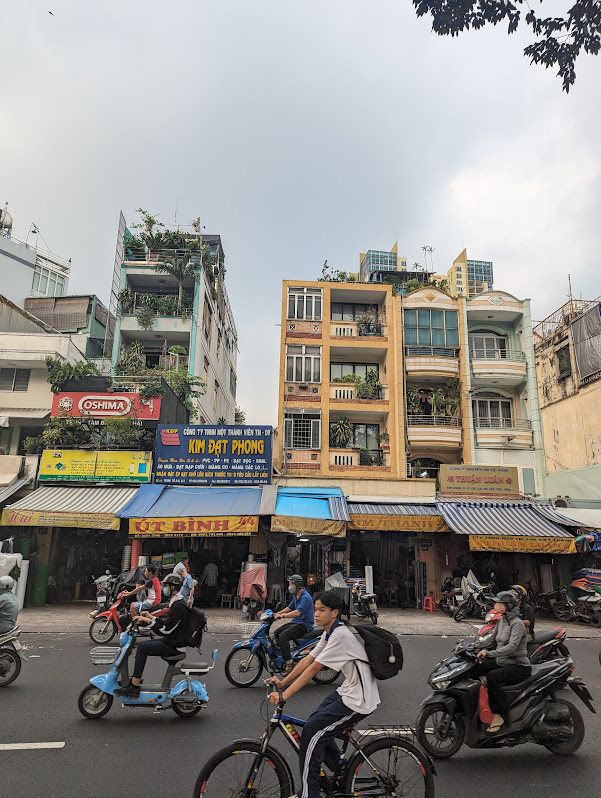
When you travel around Vietnam and Southeast Asia broadly you immediately see just about everyone getting around on motorbike
As the country quickly grows, I wanted to better understand what the impact of all these motorbikes on the environment and society
How will this change in the coming years as Vietnam becomes richer and our planet gets hotter?
Vietnam has experienced rapid population growth and economic development through the end of the 20th century and into the 21st, going from 70 million people to 100 million in just the last 30 years
As the population and economy has grown, so has motorbike ownership
And carbon emissions
Southeast Asia's motorbike ownership has now far surpassed the rest of the world, with over 80% of households in owning a motorbike
Vietnam is second only to Thailand
What has been the impact of all these motorbikes on carbon emissions and air pollution?
In the United States, transportation is the second largest source of carbon emissions.
Vietnam is a lower-middle income country going through rapid industrialization. Its total emissions are much less than those of the US, but are growing quickly
In this industrialization phase, which the US is long past, coal-fired energy generation and manufacturing dominate greenhouse gas production
However, air pollution is more than just greenhouse gases
If we expand beyond just CO2 to look at air pollution broadly, transportation dominates, especially if we focus in on cities
A 2020 study of Ho Chi Minh City attributed 95% of air pollution to transportation sources, with trucks, cars, or motorbikes dominating depending on which species of pollutant you looked at
Motorcycles are responsible for pollutants like methane, carbon monoxide, and black carbon
On the other hand, trucks are responsible for the balance of PM 2.5 particulate matter
This level of air pollution has resulted in an unhealthy environment for everyday Vietnamese people
If we look at the air quality in Hanoi in 2023, 306 days exceeded the WHO recommended Air Quality Index for 2.5 micrometer Particulate Matter
In comparison, New York City generally stayed in the safe range, except during the Canadian wildfires in the summer
We see the consequences of this poor air quality in the death statistics
Air pollution is the fourth highest cause of death in Vietnam
The country is quickly urbanizing - can it improve its urban air quality fast enough to keep up with its population streaming into its cities?
One category of solutions is the implementation of strict tailpipe emissions regulations
Vietnam implemented an emissions standard equivalent to the EU's Euro 2 standard for motorbikes in 2007, and a Euro 3 equivalent standard was implemented in 2017
However, as of 2024, while the Euro 5 guidelines apply to all new cars sold since 2022, motorbikes are still regulated under Euro 3 standards, with Euro 4 level standards published but not mandatory
Neither the Euro 2 nor Euro 3 standard regulates particulate matter pollution
Adoption of electric vehicles is still nascent
As of 2020 they represented approximately 8% of new two-wheeler sales
How will the adoption of cars impact this trajectory?
Cars are currently owned by only a small minority of Vietnamese households,
However, as people get wealthier they tend to shift to cars and increase their carbon and physical footprint
When I first started to dig into this data, I was not expecting to fall into the weeks long rabbit hole that I did
The analysis presented here is relatively crude, and every piece of new information I learned opened up 4-5 new avenues to explore that I couldn't fit into the scope here
So transportation is not as large a source of carbon emissions for Vietnam as energy generation and manufacturing - what does Vietnam's energy generation portfolio look like? What is its path to a transition to renewables? How can it clean up its industrial sector?
What about deforestation? What about the motorbike accident rate, and how many people are injured as a result of the dense traffic? What about policies to promote public transportation?
There was one thought that I kept coming back to - 3/4ths of the global population lives in a middle income country like Vietnam
They are all grappling with air pollution, and balancing it against economic development
Notes and Methodology
Data on number of motorbikes and passenger cars had to be cobbled together from different sources that each used different methodologies, so there are discontinuities that would not stand up to any kind of rigorous scrutiny, but is ballpark enough for my informal purposes
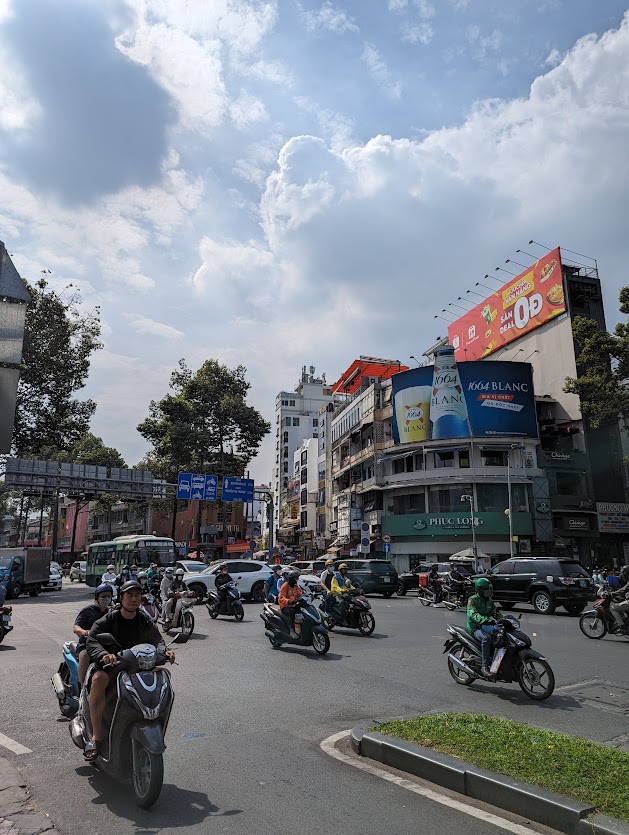
All photos my own, taken January 2024
On Data Visualization Choices:
-
On using multiple axes on one chart: Toph Tucker - Dual axes are a great way to show correlation
Motorbike data sources:
-
2015 - 2020: ASEAN Stats
-
Sales - 2007 - 2013: Lim, Guanie. (2017). Public policy with Vietnamese characteristics: the case of the motorcycle industry. Journal of Asian Public Policy. 11. 1-19. 10.1080/17516234.2017.1338326.
- Sales - 2014 - 2015: Statista
- Sales - 2016 - 2020: International Council on Clean Transportation
-
Electric Sales 2019 - 2020: International Council on Clean Transportation
-
Pecent household ownership: World Atlas
Car data sources:
-
2005 - 2015: CEIC
-
2016 - 2019: Nationmaster
-
2021: Vietnamnet
Urbanization data sources:
-
2015-2022: Statista
Population data:
GDP data:
-
GDP Per Capita: World Bank
-
Country Income Classifications: World Bank Income Groups
Carbon emissions data:
-
Over time: World Bank
-
Energy composition: IEA
Particulate matter data:
-
Pollution exposure: Our World in Data
-
Share of deaths due to outdoor air pollution: Our World in Data
Air quality data:
- Historical PM 2.5 concentrations: World Air Quality Historical Database
Health data:
- Deaths by risk factor: Hannah Ritchie and Max Roser (2022) - "Outdoor Air Pollution" Published online at OurWorldInData.org. Retrieved from: 'https://ourworldindata.org/outdoor-air-pollution' [Online Resource]